Integration platform — one runtime, twelve interfaces
A major Dutch grocery retailer, from 2021. Client abstracted; scope and measurements as delivered.
Context
The estate had accumulated integrations the way most estates do: one at a time, each a small bespoke project. Every one re-implemented authentication, retry and dead-letter handling, and each had its own idea of what an error looked like. That is affordable at three integrations and expensive at thirty. The code is not hard. The problem is that nothing is shared, so every failure is investigated from scratch by whoever built it.
The awkward constraint was that the teams building these integrations were not one team. They sat in different domains, on different backlogs, with different definitions of done.
What I built
A configuration-driven integration platform on AWS, where an interface is configuration rather than a codebase:
- One runtime, many interfaces. A single set of Lambda functions serves every interface. Interfaces differ only in Terraform configuration, a mapping file and a schema; adding one changes no runtime code.
- A fetch → transform → publish pipeline, each stage triggered by the previous stage's object landing in S3, with per-step run state recorded so a half-finished run is visible.
- Sources and destinations as adapters: event topics, REST APIs and file drops on the way in; REST, SOAP and event topics on the way out.
- Declarative mappings (JSONata), versioned so the mapping that produced a given payload can be identified after the fact.
- Authentication owned by the platform: OAuth2 client-credential flows, token caching and rotation, so an integration engineer never writes token-lifecycle code.
- An operations API behind JWT auth: replay a dead-letter message, pause an interface, purge a queue, inspect the state of a run. Open to the teams who own the interfaces, and not only to the platform team.
- Alerting by incident priority into the channel the on-call engineer is already in, with structured logs and traces behind it.
Impact
- Twelve interfaces in production on one runtime, spanning warehouse, supply-chain, master-data and CRM flows.
- ~6.7M runs a month, a dozen function errors in 30 days (September 2026). The retry, dead-letter and idempotency handling is shared, so every interface tests it at once.
- Three of the interfaces double as the lakehouse ingestion feed. The same run that carries warehouse events between operational systems lands them in Databricks, so the data platform inherits the contract, the dead-letter handling and the replay instead of rebuilding them.
- Time to a new interface in production: under a working day, from authoring the mapping, against the multi-week bespoke project it replaced.
- Failure handling, observability and replay arrive with the platform; nobody rebuilds them per integration.
- Operators diagnose and replay without console access or a ticket to the platform team.
The pattern behind it
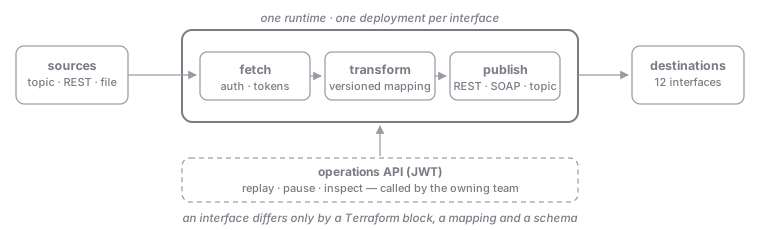
The usual objection to a shared integration runtime is the correct one: put everything on one platform and one bad change takes down every flow at once. So the code is shared and the deployment is not. Each interface is its own stack with its own queue, its own storage and its own alarms, running identical code. A team adopting the platform inherits the road without inheriting anybody else's incidents.
The interface itself is a mapping file and a Terraform block, reviewed like any other change. That is what took a new integration from a multi-week project to a day, and it is also what makes governance enforceable, because the module is the policy. Operations are self-service and API-first for the same reason: replay, pause and inspect are endpoints the owning team can call. This was the part that made adoption possible, and the part that would have been easiest to leave out. An internal platform whose operations run through its own team has only relocated the bottleneck.
We also measured before graduating to a heavier runtime. The assumption in the room was that serverless would not hold and the platform would need containers. Rather than argue it, I ran a fitness study: sweeps against ephemeral stacks on an intentionally heavy synthetic workload, plus a sustained soak. Serverless absorbed 122 messages/second sustained with headroom, at 99.78% availability over a 30-minute soak. Real production interfaces sit below 1 message/second, and the highest projected future one at roughly 7–11. The binding constraint turned out to be per-message processing cost, so the migration nobody had costed was also a migration nobody needed.
The ceiling is expressiveness. Everything the mapping language cannot express becomes either a custom transformer, an escape hatch that erodes the model a little every time it is used, or a "no". The platform is not a general ETL tool. It moves one source record to one destination call, and aggregation, fan-out and batch are out of scope. Saying no to the fourth special case is what keeps the first three cheap.
Who had to say yes
Stakeholders: the domain teams who owned the existing bespoke integrations and would have to migrate; the platform team who would carry the runtime and its on-call; the engineers on call for integration failures; and the security function, since the platform now holds the credentials for every connected system.
The disagreement: a shared runtime asks a domain team to give up code it controls, and to accept that its integration now depends on a platform someone else releases. That is a real loss of autonomy, and the blast-radius worry behind it is legitimate. From the platform team's side the concern was the mirror image: they were being handed an on-call surface for flows they did not write and whose business meaning they did not know.
What resolved it: giving the teams more operational control than they had before. The operations API means a domain team can replay, pause and inspect its own interface without AWS console access and without raising a ticket, which is a better position than owning bespoke code they have to debug from CloudWatch at 2am. One deployment per interface answered the blast-radius objection structurally. And the platform team's on-call scope was written down as the runtime, not the mappings: if a transformation produces a wrong document, that is the owning team's defect, and the run records make it possible to tell the two apart.
What it cost: the platform team took on a runtime and an on-call rota it did not have before, permanently. Every domain team gave up the freedom to solve an integration however it liked. That freedom was worth something (it is why the estate looked the way it did), and the trade only holds while the platform stays cheaper to adopt than writing it yourself. That is a standing obligation.
Role & stack
Designed and built the platform: the runtime model, the mapping and contract layer, the operations API, the alerting path, and the runtime-fitness study behind the serverless decision.
Stack: AWS (Lambda, SNS/SQS, S3, DynamoDB, API Gateway, Secrets Manager, EventBridge), Terraform, Node.js/TypeScript, JSONata, OAuth2/OIDC, Datadog.
→ This is the platform the SAP event backbone publishes into; that case study is the boundary where an SAP estate hands business events over to it. See also Integration architecture and Working across an organisation.