The AI trio — govern, build, deliver
This is the proof behind the AI & automation positioning: not slideware, but working code and reference architectures you can read. Three sibling repositories form one coherent stack.
The story
- Govern & route —
sovereign-llm-gateway. An LLM gateway with per-agent cost and budget enforcement, vendor abstraction, a local-model fallback for sovereignty, and Prometheus observability. This one runs end-to-end (docker compose up). - Build —
sovereign-copilot. A reference architecture for a trustworthy agentic product: deterministic tool contracts (MCP), retrieval grounded in your data, L1–L4 evaluation gates with goldens, and answers that trace to a recorded call chain. - Deliver —
maestro(MIT). A reference architecture for spec-driven delivery: agents propose, humans dispose, with functional and technical gates enforced through GitHub branch protection.
The honest part
One of these runs end-to-end today; the other two are reference architectures. They are not three production systems, and I won't present them as such. That honesty is the point — it's the same discipline I bring to a client's AI programme.
The pattern behind it
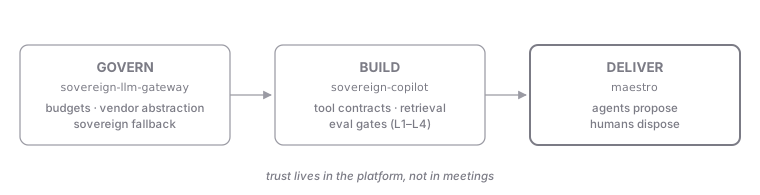
Separation of powers, applied to AI. The default shape of an "AI platform" initiative is one project that mixes model access, product logic and delivery automation — which means nothing can be governed, evaluated or swapped independently. The trio splits it along the lines that actually move at different speeds: models churn monthly, products quarterly, delivery practice yearly.
Two decisions carry the pattern:
- Govern at the choke point, not in a policy doc. Budgets, vendor abstraction and the sovereignty fallback live in the gateway — the one place every model call passes. Governance you can
docker compose upbeats governance you circulate as a PDF. - Eval gates are the schema registry of AI. L1–L4 gates with goldens do for agent behaviour what schema compatibility rules did for Kafka producers in the Cloudera case study: they move trust from review meetings into the platform, so change can be fast and safe.
The honest part above still applies — one of the three runs end-to-end, two are reference architectures. The pattern is the claim; the labels say how much of it is proven.
Why it matters
Together they map onto how I run AI delivery for real: govern the models, build a product you can trust on top of them, and deliver software with agents under human control.
→ See the repositories on the portfolio (links open once the public-surface prerequisites close).