Retail dynamic pricing — one lakehouse, two pricing strategies
This is applied pricing science for retail: a dynamic-pricing platform that turns sales history into demand elasticities, optimizes shelf prices under real business constraints, and explains every move. One engine, two verticals that differ in what they optimize, not how it's plumbed — all of it runnable on a laptop and built to lift to a Databricks lakehouse unchanged.
The two verticals
The interesting part of retail pricing is that the science is genuinely different by category — so I built one core and pointed it at two constraint sets:
- Grocery — elasticity & markdown pricing. High SKU count, thin margins, perishability. The levers are demand elasticity, KVI price-image (the known-value items shoppers benchmark you on), the category price ladder (private label < A-brand < premium), and expiry-driven markdown to recover value before write-off.
- Electronics — competitive & lifecycle pricing. Lower SKU count, high ticket, ruthless online price transparency. The levers are competitor price-matching, MAP compliance (the manufacturer's Minimum Advertised Price is a hard floor), product-lifecycle markdown (hold at launch, clear at end-of-life), and attach economics (the accessory/warranty margin that makes the unit margin misleading).
What I built
A shared, solver-agnostic engine — generate → estimate elasticity → optimize → markdown → explain — with two end-to-end notebooks, one per vertical:
- A demand model that fits own-price elasticities per SKU (log-log with store-cluster / channel fixed effects in the demo; LightGBM/GPBoost with monotonicity constraints in production). The notebooks check the fitted elasticities against a known ground truth baked into the synthetic data.
- A revenue optimizer over a non-linear (price × demand) objective with the constraints a category manager actually enforces — cost floor, price ceiling, margin floor, price ladder, MAP floor, max-change. It's solver-agnostic: SciPy/SLSQP by default so anyone can run it, with a Gurobi MIQP backend for the full max-N-changes cardinality constraint, falling back gracefully.
- A Databricks lakehouse mapping: Delta Live Tables for bronze→silver→gold, MLflow for the elasticity model, a Workflow tying ingest → train → optimize → publish, and a Mosaic-AI agentic layer that turns natural-language pricing policy into constraints and renders a per-role rationale for every price.
The honest part
It all runs on a laptop in seconds because it trains and optimizes on synthetic but plausible data — a seeded data-generating process with a known elasticity per SKU, so recovery is checkable and the whole thing is reproducible. That's a deliberate choice, and the repo says so everywhere. The economics are real in direction and shape: grocery clears +6.4% revenue at flat margin with the milk price-ladder intact; electronics moves only ~+1% because MAP floors and tight ceilings genuinely leave little room — several SKUs want to drop but are pinned at the MAP floor, which is itself the realistic compliance signal. The Databricks pipelines are reference implementations; the laptop path is the notebooks. Every file draws the line between demo and production.
The pattern behind it
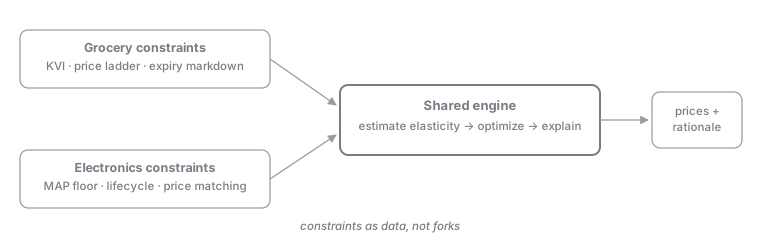
One engine, constraints as data. The default fate of a pricing platform serving two verticals is a fork — grocery and electronics each get "their" engine, and within a year they're two products sharing a logo. Here the vertical difference is expressed entirely as constraint sets over one solver-agnostic core: KVI price-image and expiry markdown for grocery, MAP floors and lifecycle curves for electronics. The engine doesn't know which retail it's pricing.
Two decisions carry the pattern:
- The constraint set is the product surface. A category manager's rules — cost floor, ladder, MAP, max-change — enter as declared constraints, not as code branches. That's also what the Mosaic-AI agentic layer builds on: natural-language policy compiles to constraints precisely because constraints are data.
- Test the science, not just the code. The synthetic data has a known elasticity per SKU baked in, so the notebooks can check that the model recovers the truth — a ground-truth harness most pricing stacks never have.
The trade-off to know upfront: generality is a discipline you keep paying for. The third vertical will arrive with "just one special case" that wants to live inside the engine — the moment it does, you're back to a fork with extra steps. Saying no is part of the architecture.
Why it matters
It shows the full arc on one surface: the data science that turns price history into a defensible elasticity, the operations-research that turns elasticities and business rules into prices, and the lakehouse + agentic architecture that would actually run it at a retailer — not just one slice.
→ See the repository — runnable notebooks for both verticals.
→ See also Data & lakehouse and AI & automation.