Per-object crossing mode
Choose share, replicate, federate, split or keep for each object, by ordered rules and a crossover cost.
Problem
Data has to cross from one platform to another, an ERP into a warehouse for example, and the estate picks one integration style for all of it: replicate everything, or federate everything. Each object then pays the cost profile of a mode that was chosen with some other object in mind.
Forces
- Replication is mostly fixed cost: the initial load, delta movement, storage at rest, and a pipeline someone operates. The copy is as fresh as its last successful run.
- Federation is mostly variable cost. The source answers every query, so the result is current, and the source carries the load each time, month-end close included.
- A zero-copy share removes most of the fixed cost and raises the marginal cost. Its freshness is the producer's promise.
- Some objects carry semantics (currency conversion, hierarchies, annotations) that are expensive to rebuild downstream.
- Residency, personal data and delta capability rule modes out before cost comes into it.
Solution
Decide the crossing per object, from five modes:
| Mode | Fits when |
|---|---|
| Share | the source delivers a data product; semantics are rich; query frequency is moderate |
| Replicate | the object can deliver a delta, and is queried often enough for a copy to pay |
| Federate | queries are rare, must be current, and the source can take them at peak |
| Split | one object is two workloads: a dashboard on the aggregate, a rare line-item drill-down |
| Keep at source | residency or personal-data rules bind it there |
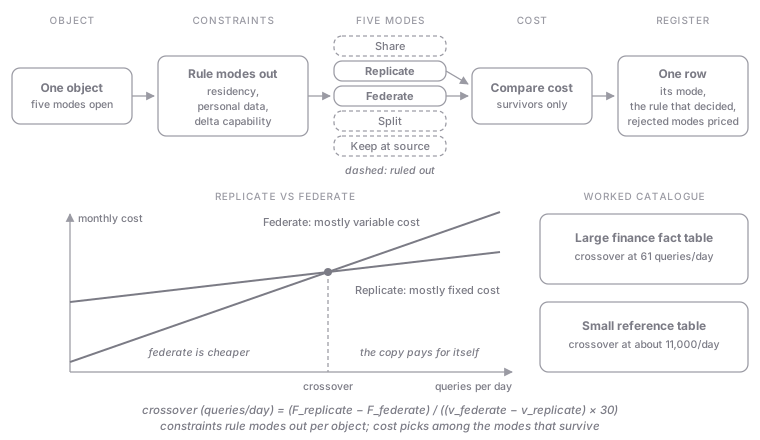
Run the constraints first (G-03), then compare the surviving modes on cost. Between replication and federation that comparison is two straight lines, and they meet:
crossover (queries/day) = (F_replicate − F_federate) / ((v_federate − v_replicate) × 30)
Below the crossover, federate. Above it, the copy pays for itself. The result goes into a register: each object, its mode, the rule that decided it, and what the rejected modes would have cost.
Consequences
- The argument shrinks to two numbers per object, what a query costs the source and what the pipeline costs per month, and a room can settle two numbers in an afternoon.
- Objects with different economics get different answers. On the worked catalogue a large finance fact table crossed over at 61 queries a day, where a small reference table needed about 11,000.
- More modes means more kinds of operation to run, monitor and explain.
- A share is a copy someone else operates. Plan around the producer's refresh cadence.
When not to use it
- A handful of objects: decide them together in one ADR.
- The target has no federation or sharing path. One mode remains and the question is closed.
- Volumes where cost and freshness do not matter: pick the simplest mode and move on.